Furniture for Living

ROUTE 01 // POSTURE, SPAN & STACKABILITY

A chair or table is not a static sculpture; it is a mechanical tool that bears human weight for thousands of hours while leaving enough floor circulation for daily tasks. In the Nordic workshop tradition pioneered by Kaare Klint’s Department of Furniture at the Royal Danish Academy of Fine Arts in 1924, every dimension starts with human anatomy and the things stored inside a piece.

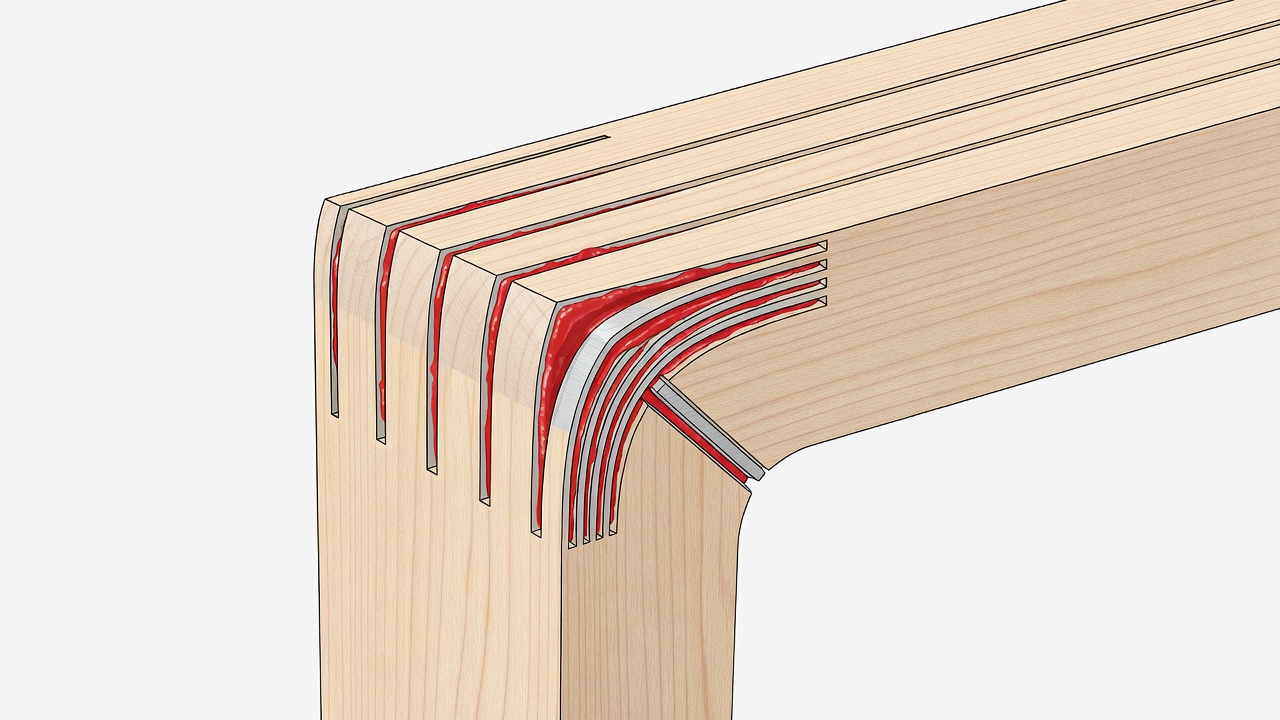
STUDY 1.1 // LAMINATED CANTILEVER & L-LEG RADIUS: 42 MM BEND
Vector technical diagram in black, crimson, and silver showing five saw kerfs at the end of a solid birch leg filled with glue-soaked veneers and bent 90 degrees

The steamed knee that eliminated the apron frame

Conventional wooden chairs require a perimeter rail (apron) underneath the seat to prevent the legs from splaying outward under load. That rail consumes knee clearance and adds four mortise-and-tenon joints that loosen in dry winter heating. Collaborating with master cabinetmaker Otto Korhonen in Turku, Alvar Aalto cut parallel saw kerfs into the end of a solid birch billet, inserted thin veneers coated in casein glue, and bent the timber 90 degrees in a heated press.

Because the horizontal foot of the "L" screws directly into the underside of the circular seat, the leg becomes a self-bracing bracket. The same L-leg scales up in thickness to support child stools, six-person dining tables, and library desks, creating a unified structural vocabulary across an entire apartment.
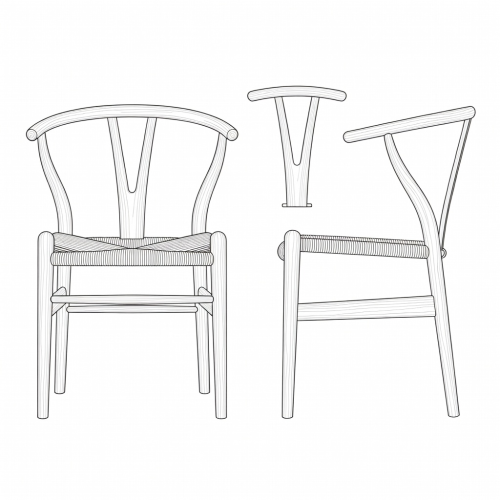
STUDY 1.2 // STEAM-BENT RAIL CH24 WISHBONE GEOMETRY
Vector front and side elevation of a steam-bent top rail and Y-shaped back splat over a woven paper cord seat

Combining backrest and armrest in a single rail

Hans J. Wegner’s 1949 CH24 chair merges the top rail and armrests into a single steam-bent semicircle supported by a Y-shaped central splat. By angling the rear legs slightly backward and tapering them toward the floor, the chair provides full elbow support while allowing the diner to sit sideways or pull close to the table edge.

Anthropometric storage and knock-down architecture

KAARE KLINT RATIO // FLAT-PACK ORIGINS
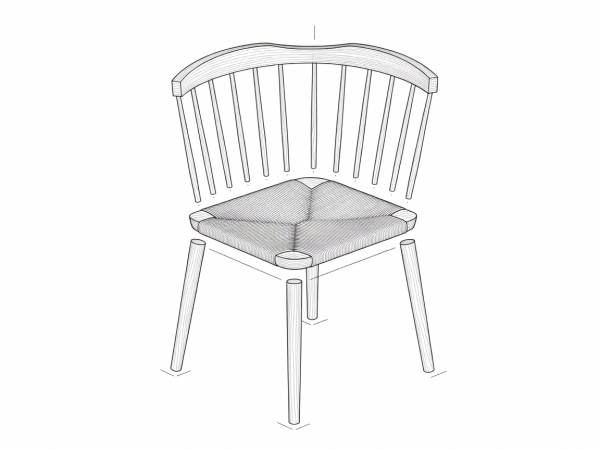
STUDY 1.3 // THE J39 PEOPLE'S CHAIR BØRGE MOGENSEN, 1947
Vector exploded view of a simple turned-leg oak chair with curved laminated backrest and envelope-woven cord seat

Turned cylinders for lathe efficiency

To keep prices accessible for post-war families, Mogensen specified cylindrical turned legs and stretchers that could be produced rapidly on automatic lathes without complex jigging. Because the components meet in round-tenon sockets, any household can re-glue a loose stretcher decades later without specialized clamps.

STUDY 1.4 // WALL-HUNG & KNOCK-DOWN DIMENSIONS DEPTH EFFICIENCY

Why 300 mm depth handles 92% of domestic objects

Most storage sideboards are built 500 mm to 600 mm deep, resulting in a dark back row of forgotten crockery and wasted floor width. When Kaare Klint and later Nisse Strinning catalogued household possessions—octavo and quarto books, dinner plates (260 mm diameter), wine glasses, and folded linen—they proved that a 300 mm shelf depth holds almost everything in a single visible row.

Object Category Standard Dimension Ideal Shelf Depth Vertical Pitch Clearance
Hardcover Fiction & Monographs 155 mm × 235 mm 200 mm wire ladder 250 mm between shelves
Vinyl LP Records & Art Folios 315 mm × 315 mm 300 mm shelf (15 mm overhang) 350 mm with vertical dividers
Stack of 12 Stoneware Dinner Plates Ø 260 mm × 140 mm high 300 mm cabinet module 200 mm for easy two-hand lift
Drop-Leaf Writing Desk Insert 780 mm × 580 mm open 300 mm closed profile Mounted at 720 mm floor height

In 1956, Gillis Lundgren applied this spatial logic to shipping volume when he removed the legs from the Lövbacken leaf-shaped side table so it would slide flat into the back seat of a Volvo PV444—establishing the knock-down dowel-and-cam standard used across modern apartments.