Light with Purpose

ROUTE 02 // BAFFLES, REFLECTORS & KELVIN

At latitude 60° North, December brings less than six hours of low-angle twilight, meaning domestic life unfolds under artificial lamps for three-quarters of the day. If a light fixture exposes a bare filament or LED emitter to the eye, the pupil constricts, making the surrounding room look gloomy even when total lumen output is high. Nordic lighting engineering treats the bulb as raw energy that must be redirected, softened, and warmed before it reaches human vision.

STUDY 2.1 // LOGARITHMIC REFLECTION PH 5 OPTICAL CUTOFF
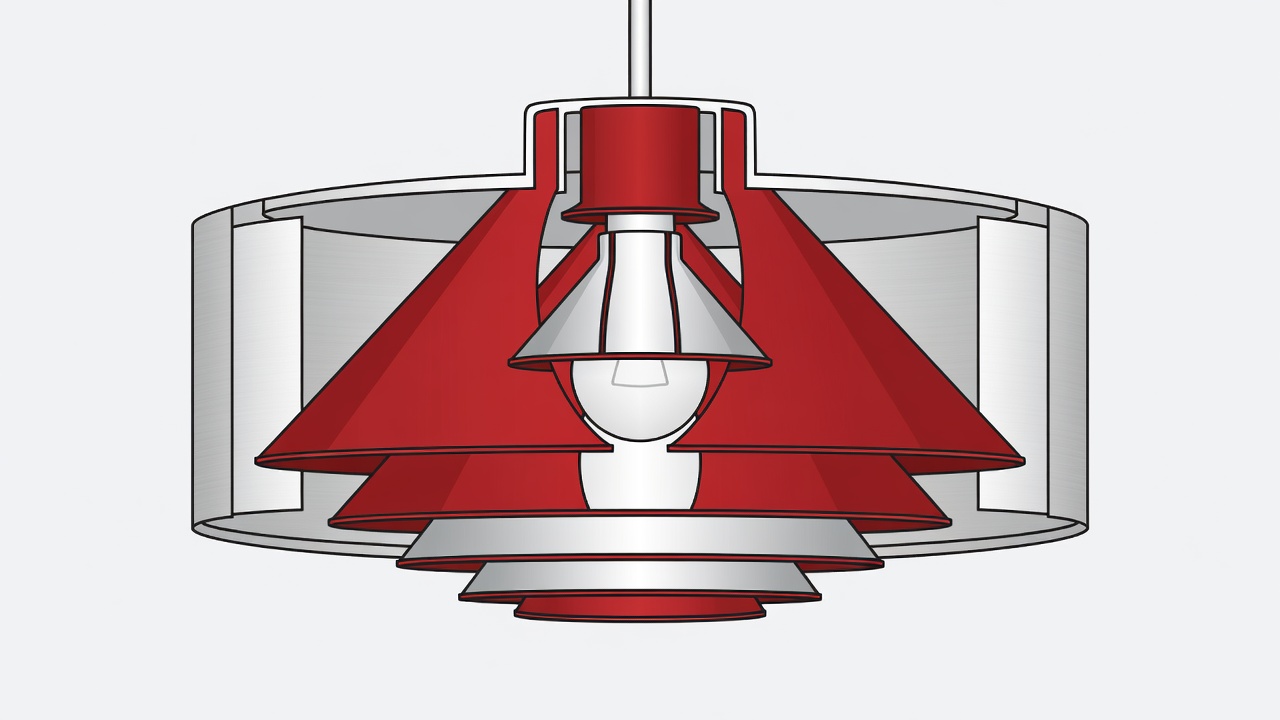
Vector cross-section of a five-element spun aluminium pendant showing internal crimson and silver reflector cones blocking direct sightlines to the bulb

Why the inside of a shade is sandblasted matte

When Poul Henningsen engineered the PH 5 for Louis Poulsen in 1958, he solved two problems simultaneously: hiding the bulb from any viewing angle and correcting the cold spectral spike of modern bulbs. While the outer surfaces of the spun aluminium shades are finished in satin lacquer to wipe clean of kitchen grease, the undersides are sandblasted matte white so reflected rays scatter softly rather than casting hard mirror rings on the table.

Inside the central column, Henningsen placed a small crimson reflector ring and a contrasting inner diffuser cone. Light bouncing off the crimson band warms the colour temperature around the dining table, lending skin tones the natural glow of an evening candle without sacrificing reading clarity at the centre of the table.
STUDY 2.2 // HAND-PLEATED DIFFUSION LE KLINT CROSS-PLEAT
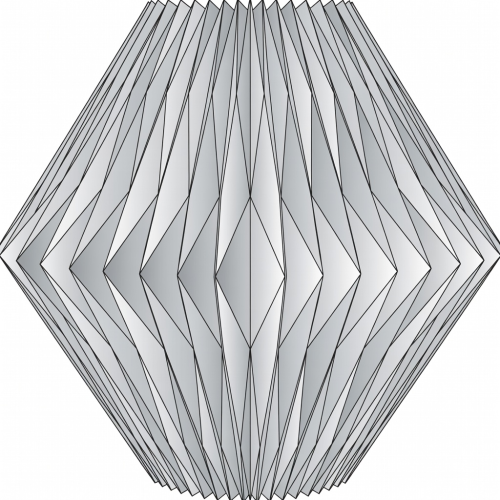
Vector isometric drawing of a hand-folded diamond-pleated lantern shade in silver and black linework

Self-supporting folded sheet geometry

Architect P.V. Jensen-Klint folded paper shades that snap onto a wire collar without glue or screws. The alternating zig-zag scores stiffen thin PVC or paper into a rigid lantern that turns a harsh point source into an even, glowing sphere.

Articulated mechanics and perforated brass

SPRING EQUILIBRIUM // PERFORATION DENSITY
STUDY 2.3 // PARALLEL SPRING ARM JACOB JACOBSEN, 1937
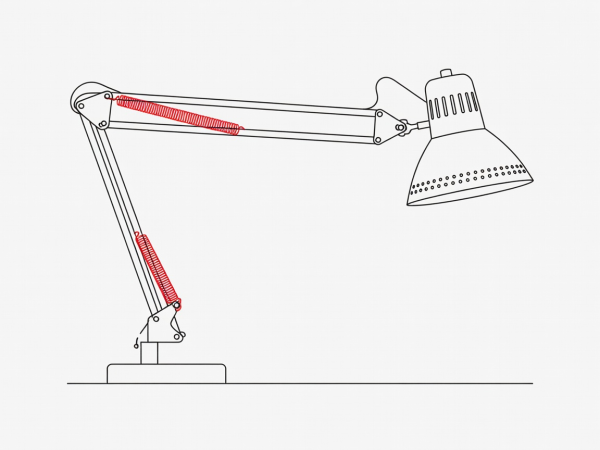
Vector side elevation of an articulated desk lamp with four crimson tension springs holding a vented cone shade over a desk

Zero-friction positioning

Before the Luxo L-1, adjusting a work lamp meant loosening hot wingnuts with two hands. By adapting the biomechanics of the human arm—using two parallel steel tubes counter-balanced by exposed helical tension springs—Jacobsen created a shade that glides with a single fingertip and stays locked in space.

STUDY 2.4 // DOUBLE-SHADE & PERFORATED RIMS PAAVO TYNELL & AALTO A330S

Preventing the "dark ceiling cave" effect

Opaque metal spun pendants focus 100% of their flux downward, which can leave the upper walls and ceiling in heavy shadow. Finnish designers Paavo Tynell and Alvar Aalto solved this by piercing the brass collar or neck of the shade with precise rows of 2 mm ventilation holes. Rising convective heat escapes through the perforations—extending bulb life—while a halo of warm brass-tinted light washes upward across the ceiling plaster.

Room Zone Target Illuminance Recommended Kelvin Fixture Placement Rule
Dining Table Surface 250–300 lux on centre 2400K – 2700K 600–680 mm from tabletop to bottom rim
Work Desk / Drafting 500 lux on paper 2700K – 3000K CRI 95 Opposite dominant writing hand to stop pen shadow
Window Sill / Corner 80–120 lux ambient 2200K – 2600K 150 mm from glass to soften night reflection